The cost of buying a home in Colorado Springs depends on more than the purchase price. You need to plan for the down payment, closing costs, monthly mortgage payment, property taxes, homeowners insurance, and the ongoing cost of maintaining the property.
Two buyers purchasing homes for the same price can have very different monthly payments and upfront costs. Their loan programs, interest rates, down payments, insurance costs, and property taxes may all differ.
I'm Kevin James Bond, a REALTOR® with REMAX Real Estate Group. I've lived in Colorado Springs since 1992 and have helped buyers navigate the local market since 2016. Here's how I recommend thinking through the numbers before you start looking at homes.
1. How much money do you need for a down payment?
Your down payment is the portion of the purchase price you pay upfront rather than borrow.
You do not necessarily need 20% down to buy a home. Depending on your qualifications and loan program, you may be able to buy with substantially less.
Here is what different down payments look like on a $500,000 home.
Down Payment | Amount |
|---|---|
3% | $15,000 |
3.5%` | $17,500 |
5% | $25,000 |
10% | $50,000 |
20% | $100,000 |
These are examples, not loan approvals. The minimum down payment depends on the loan program, lender requirements, credit profile, and property.
Some conventional loans allow eligible buyers to put down as little as 3%. FHA loans can offer down payments as low as 3.5% for qualifying borrowers. Eligible VA borrowers may be able to purchase with no down payment, subject to the program's rules and the transaction.
A smaller down payment means you borrow more money. It may also mean paying mortgage insurance or accepting different loan terms. That does not automatically make a low-down-payment loan a bad choice, but it is worth comparing the total cost.
2. What are closing costs?
Closing costs are expenses associated with finalizing the purchase and mortgage. They are separate from your down payment.
The Consumer Financial Protection Bureau estimates that closing costs commonly range from 2% to 5% of the purchase price, although the actual amount varies by transaction.
For a $500,000 home, that would be approximately $10,000 to $25,000 before accounting for any seller credits, lender credits, or other adjustments.
Potential expenses include:
- Loan origination and other lender fees
- Appraisal and credit-related charges
- Title services and title insurance
- Recording and government fees
- Prepaid homeowners insurance
- Property tax and insurance escrow deposits
- Prepaid mortgage interest
Some expenses are negotiable, and the purchase contract determines which party is responsible for particular costs. A seller may agree to contribute toward a buyer's closing costs, subject to the loan program's limits and other requirements.
Earnest money is another important part of the transaction. It is typically deposited after the contract is signed and credited toward the buyer's funds at closing. It is not automatically an extra expense on top of the down payment and closing costs, although the timing means you need access to the funds before closing.
You should also budget for expenses that may fall outside the lender's closing-cost estimate, including moving, utility deposits, immediate repairs, and new furniture or appliances.
3. What will your monthly mortgage payment be?
Your monthly housing payment may include several different expenses:
- Principal and interest on the mortgage
- Property taxes
- Homeowners insurance
- Mortgage insurance, if required
- Homeowners association dues, if applicable
Some homes also have special district taxes or other property-related expenses. These vary by location and property.
Consider a hypothetical $500,000 purchase with a 3.5% down payment and a 30-year fixed-rate mortgage at 7.5% interest.
The down payment would be $17,500, leaving a loan amount of $482,500.
The estimated principal-and-interest payment would be about $3,374 per month. This is an illustration using the stated interest rate, not a current rate quote or a complete housing payment. It also doesn't include property taxes, homeowners insurance, mortgage insurance, HOA dues, utilities, or maintenance. Those additional expenses can make a substantial difference. Before choosing a price range, ask a lender to estimate the full monthly payment for a property in the areas where you want to live.
4. How much should you budget for property taxes and insurance?
Property taxes in Colorado Springs and the surrounding El Paso County area vary by property, taxing districts, assessed value, and applicable tax rules. Do not assume two homes with similar sale prices will have identical tax bills. Check the actual property tax information for the home you are considering. With that being said, the average suburbia house in Colorado Springs could roughly cost about $2,000 to $2,500 in yearly property taxes.
Homeowners insurance also varies. The home's age, roof, construction, location, replacement cost, coverage limits, deductible, and claims history can affect the premium and availability of coverage. Again, the average house in Colorado Springs could cost you about $2,000 a year in home insurance. Different things will affect that yearly amount, so check with your homeowner's insurance upfront. Colorado buyers should pay particular attention to insurance early in the transaction. Obtain quotes for the specific property rather than relying only on a generic estimate.
Your lender will generally require appropriate homeowners insurance before closing on a mortgaged property.
5. What about maintenance and repairs?
When you rent, the landlord is generally responsible for many property repairs. When you own a home, those costs become yours.
A home inspection can help identify visible problems with the roof, heating and cooling systems, plumbing, electrical components, foundation, and other parts of the property. Additional inspections may be appropriate depending on the home's age, condition, and features. In Colorado Springs, I would also pay attention to the roof and exterior condition, drainage, heating systems, and any signs of water intrusion. The specific concerns depend on the property.
An inspection does not guarantee that a home will be free of problems. You should keep money available for both routine maintenance and unexpected repairs.
A home that barely fits your budget on the day you buy it may become difficult to afford when the water heater fails or the roof needs attention.
6. Are there programs to help with the upfront costs?
Some buyers may qualify for down payment or closing-cost assistance. The Colorado Housing and Finance Authority, or CHFA, offers homebuyer financing and assistance options through participating lenders. Depending on the program and your eligibility, assistance may be structured as a grant or a second mortgage. These options have different repayment requirements and costs. You can review current options at CHFA's down payment assistance page: (https://www.chfainfo.com/homeownership/down-payment-assistance).
Ask a participating lender about current eligibility, income and purchase-price limits, required education, and whether the assistance changes your interest rate or creates a repayment obligation.
Do not assume that assistance is free money or that every buyer will qualify.
7. How much house can you comfortably afford?
A lender can tell you how much you may qualify to borrow. That is not necessarily the amount you should spend. Think about your monthly budget after housing costs, including transportation, food, childcare, debt payments, savings, and other obligations. Consider whether your income is stable and whether you expect significant changes in the next few years. You should also keep an emergency reserve rather than using every available dollar for the down payment and closing.
I recommend comparing loan estimates from multiple lenders. Look at the interest rate, fees, mortgage insurance, cash needed at closing, and projected monthly payment. A loan with a lower advertised rate is not necessarily the least expensive once the other costs are included.
The Consumer Financial Protection Bureau's mortgage shopping guide: (https://www.consumerfinance.gov/consumer-tools/mortgages/shopping-for-a-mortgage/) explains what to compare.
8. Should you rent or buy?
Buying can make sense if you expect to stay in the home long enough to offset the costs of buying and eventually selling, and if you can comfortably manage the ongoing expenses. Renting may make more sense if you are uncertain about how long you will stay, need flexibility, or would have difficulty covering unexpected repairs.
Home prices can rise or fall. Equity builds over time as you pay down the mortgage, but appreciation is not guaranteed. Buying a home is not a reliable short-term investment simply because housing prices have historically increased over longer periods. If you are moving to Colorado Springs from another city, renting first may give you time to learn the area before committing to a particular neighborhood.
9. What is the Actual Cost to Buy A Home in Colorado Springs?
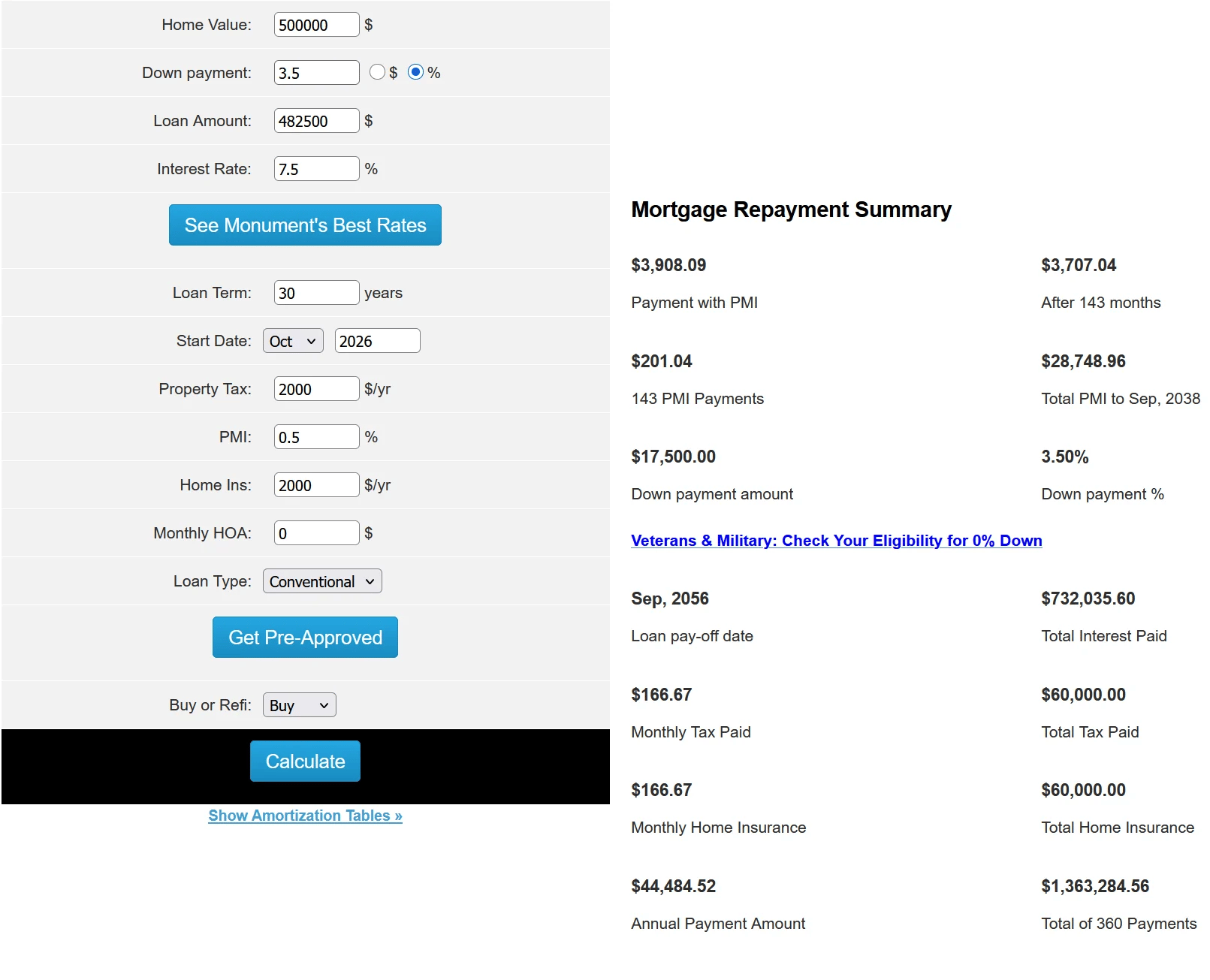
Here's an example chart showing everything we've covered in the cost to buy a home in Colorado Springs. It includes an example down payment of 3.5%, assumes a 7.5% mortgage interest rate, mortgage insurance, $2,000 in yearly property taxes, and $2,000 a year in homeowner's insurance. If you'd like to play around with the numbers yourself, mortgagecalculator.com is a great resource!
Planning your home purchase
Before you start touring homes, work out two numbers: how much cash you can safely put toward the purchase and how much you can comfortably spend each month. Those numbers will help narrow your search and make it easier to compare properties and loan options.
I'm happy to help you understand the local market, evaluate homes, and compare the practical trade-offs involved. A good purchase starts with understanding the numbers, not with choosing the most expensive home a lender will approve.
Related resources: [Buying Your First Home in Colorado Springs] | [Understanding Mortgage Options] | [Assumable Mortgages: How They Work]
About the author: Kevin James Bond is a Broker Associate and REALTOR® with REMAX Real Estate Group in Colorado Springs, Colorado. He has lived in Colorado Springs since 1992 and has worked in real estate since 2016.
This article provides general educational information, not a loan quote, tax advice, or financial advice. Loan terms, program eligibility, taxes, insurance, and closing costs vary by transaction. Verify current details with qualified professionals.