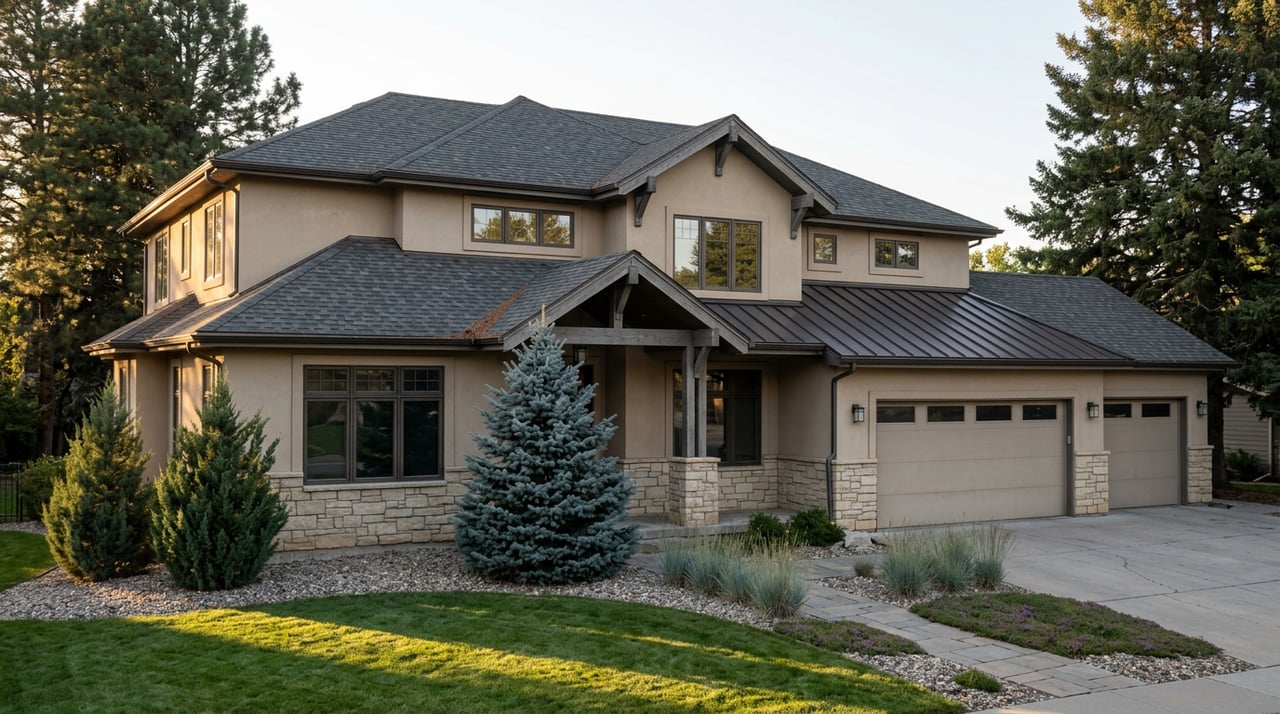
How do two houses on the same Colorado Springs cul-de-sac, put up within a year or two of each other, end up a million dollars apart on the market?
That's the question a buyer runs into fast on Parapet Court in Sunset Mesa. County records put the average home on that street at right around 1991, the same stretch of years the rest of the neighborhood went up. The Sunset Mesa Neighborhood Association itself was established in 1992. Walk the cul-de-sacs and you're looking at a single, coherent building era, not a patchwork of decades. And yet this year one Parapet Court listing carried a price near $1.74 million for 7,068 finished square feet on six bedrooms and six baths, while a few doors down, a similarly aged 5,298-square-foot home on the same street carried an automated valuation closer to $835,000, with recent nearby resales landing between roughly $650,000 and $935,000. Same street. Same era. Very different math.
If you're comparing Sunset Mesa to other Colorado Springs neighborhoods using a single reported price, that number is doing less work than it looks like it's doing.
The Numbers Don't Line Up the Way You'd Expect
Start with the entry point. Two current listings give you a feel for what a standard, unmodified Sunset Mesa home costs today. A four-bedroom, three-bath house on Saddle Rock Trail was priced at $624,500 for 3,076 square feet. A similar four-bedroom, three-bath on Teakwood Terrace listed at $619,000 for 2,603 square feet. Both land in the mid-$200-per-square-foot range, which tracks reasonably close to what the rest of Colorado Springs was doing this year. Citywide, the median sale price over the three months ending August 2026 sat around $460,000, down about 3.2 percent from the year before, with homes typically going under contract in 42 to 43 days.
Then there's Parapet Court. The same street that averages a 1991 build year and a roughly 16,461-square-foot lot per county assessor data also produced that $1.74 million listing, an outlier that sits on a lot closer to three-quarters of an acre, nearly double the street's typical parcel. A separate address on the same street, built in 1989 at 5,298 square feet on a standard 10,777-square-foot lot, last changed hands in 2013 for $440,000 and carries a present-day automated valuation in the mid-$800,000s.
| Address type | Built | Finished sq ft | Lot size | Recent price |
|---|---|---|---|---|
| Saddle Rock Trail | Era-typical | 3,076 | Standard | $624,500 |
| Teakwood Terrace | Era-typical | 2,603 | Standard | $619,000 |
| Parapet Ct (standard) | 1989 | 5,298 | 10,777 sq ft | Est. mid-$800,000s |
| Parapet Ct (outlier) | Era-typical | 7,068 | ~34,413 sq ft | ~$1.74M |
None of these homes are new construction. None of them are in a separately platted luxury phase. They're the same generation of house, built for the same subdivision, sitting under the same HOA covenants.
Nearly Everyone Backs to the Same Open Space, So That's Not the Variable
If you're trying to explain the spread by location within the neighborhood, that theory runs out of room fast. Sunset Mesa was built as a collection of cul-de-sacs where the great majority of lots back directly onto the Sunset Mesa Open Space, the rugged stretch of rock outcrops and hoodoos that climbs above the neighborhood's north edge. The Gazette covered the open space as essentially a private backyard park for the neighborhood, noting the city doesn't actively develop or promote trails there. AllTrails logs the main route through it as a 3.2-mile out-and-back with 347 feet of elevation gain, easy to reach, less easy to find a place to park.
That open space access is close to universal here, not a premium a handful of lots get to claim over their neighbors. A house on Saddle Rock Trail and a house on Parapet Court both likely have that same rock-formation backdrop. So the view isn't the mechanism. The lot backing isn't the mechanism. What's left is what happened to the house after it was built.
Thirty-Plus Years Gives a House a Lot of Time to Change
Colorado Springs has spent the last several years pushing homeowners toward a specific decision: expand where you are instead of buying somewhere else. Local remodeling contractors describe this directly, framing it as a response to tight inventory and low turnover across the city's established neighborhoods, the kind of market where staying and building out beats competing for a new listing. A local remodeling firm serving the Colorado Springs area put it plainly, that more homeowners are choosing to remodel and expand their existing homes rather than move.
The cost structure supports that math. Additions along the Front Range typically run somewhere between $160 and $420 per square foot depending on finish level and structural complexity, with most homeowners landing in the $200 to $320 range. A second-story addition or a major kitchen and primary suite expansion easily adds hundreds of thousands of dollars in construction cost, on top of whatever the original 1990s-era house was worth. Do that once, on a lot that was already larger than most of the street's, and a standard three-bedroom rancher becomes a six-bedroom, six-bath house with double the typical lot size and a price tag that has nothing to do with its original 1991 blueprint.
That's the actual story behind Sunset Mesa's price spread. It isn't a location premium. It's three decades of individual owners making individual decisions about whether to expand, and how far.
One more wrinkle worth flagging: not every listing tagged "Sunset Mesa" online is necessarily inside the neighborhood's actual boundary. At least one recent listing search returned a townhome carrying a zip code associated with a different part of north Colorado Springs entirely, grouped in under the same neighborhood label. When you're comparing prices across a small subdivision like this one, the aggregation itself can be doing some of the misleading work before you even get to the individual houses.
What This Means If You're Comparing Sunset Mesa to Somewhere Else
If a portal or a market snapshot hands you one number for Sunset Mesa, here's what to check before you treat it as representative of what you'd actually pay:
- Ask for the county-assessed build year on the specific address, not just the neighborhood's general era. A few years of gap can still mean a meaningfully different original floor plan.
- Compare finished square footage against the original permitted footprint if you can get it. A jump from roughly 2,600 square feet to over 7,000 usually means an addition, not a bigger original build.
- Check lot size against the street average. An outlier lot close to double the typical parcel, like the one on Parapet Court, often signals either an assembled double lot or a home built with more room to expand later.
- Pull permit history through the Pikes Peak Regional Building Department for any address you're seriously considering. Additions and second-story work require permits and inspections, and that history tells you what actually changed and when.
- Don't anchor on a single comp. With this few active listings in a small subdivision, one $1.7 million outlier can distort a simple average badly.
None of this means Sunset Mesa is unpredictable in a bad way. It means the neighborhood rewards homework that a headline median can't do for you. A buyer who understands that a specific Sunset Mesa address is really two data points, the 1991 original and whatever's been added since, walks into a showing with a much clearer sense of what they're actually paying for.
A Few Quick Answers
Is Sunset Mesa a good investment given how spread out the prices are? That depends on the specific house: the examples here range from about $619,000 to $1.74 million, with a standard-lot Parapet Court home estimated in the mid-$800,000s. A higher or lower price doesn't inherently make a house the better buy. It comes down to what you want and whether the specific house's history matches the price being asked.
Does backing onto the open space add resale value? Given how close to universal that backing is across the neighborhood, it functions more as a baseline expectation than a differentiator between one Sunset Mesa listing and the next.
Why did homes here get expanded instead of the owners just moving? Colorado Springs' tight inventory over the past several years made staying and building out a more practical option for a lot of owners than competing for a new listing citywide, and the construction cost math on additions has generally supported that choice.
If you're weighing a Sunset Mesa listing against something in a different part of town, or trying to figure out whether a specific address's price reflects its original build or three decades of additions on top of it, that's exactly the kind of question worth working through with someone who knows the street-by-street history, not just the neighborhood-level number. Kevin James Bond has been local since 1992, the same year this neighborhood's HOA got its start. Let's Connect.
This article is general information, not legal, tax or financial advice. Consult a qualified professional about your situation.